

.jpg)
When Wes Anderson’s stop-motion animated Isle of Dogs was released earlier this year, the film was highly praised for its handcrafted style. The director leaned heavily on real puppets and real sets to tell the Japan-based story of a group of dogs relegated to a trash island. But, as is the case with many stop-motion films these days, visual effects helped play a significant role in producing the final images.
An in-house VFX team, led by Senior Visual Effects Supervisor Tim Ledbury, would touch every single frame of Isle of Dogs in some way – for a total of 950 shots. Ledbury, whose previous credits include other stop-motion films such as Frankenweenie and Fantastic Mr. Fox, told VFX Voice about the range of visual effects work required for Anderson’s film.
In this featurette, see how various stop-motion elements were combined to form the final frames of Isle of Dogs.
VFX Voice: Not everyone would think that a film like Isle of Dogs would involve so many visual effects – how much a part of the animation effort is visual effects in the production?
Tim Ledbury: Visual effects is quite integrated into Isle of Dogs because the whole film is essentially an effect. And in this particular film, it’s the first time compared to the other films I’ve done where we actually worked on every shot in the movie in some capacity. Normally you work on about 80% of the film, but on this one we actually hit the 100%.
VFX Voice: What did that work entail?
Tim Ledbury: There are the more obvious shots which required shooting over 90 elements and putting them together, using bits of CG to combine and track and fit them together. We shot 8,000 elements; certainly, we ingested 8,000 elements into the effects. Then there’s all the general rig removal from the puppets that has to happen on any of these films.

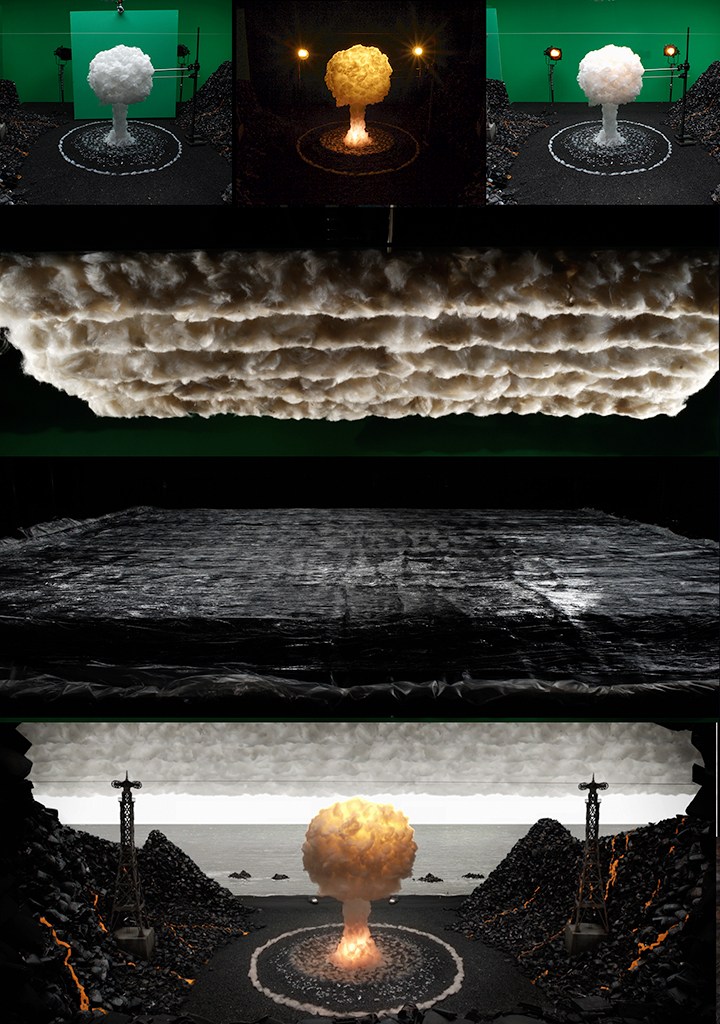
These frames show the various stop-motion animation plates, miniatures and extra elements that were composited to form a final shot of Trash Island.
“Visual effects is quite integrated into Isle of Dogs because the whole film is essentially an effect. And in this particular film, it’s the first time compared to the other films I’ve done where we actually worked on every shot in the movie in some capacity.”
—Tim Ledbury, Senior Visual Effects Supervisor
Also, Wes changed the way he was doing the face animation – all the replacement heads were hand-painted and that meant more visual effects because there was a lot of variation. When you run a shot you get a lot of color change and popping. On one of the characters, Tracy, her face had freckles and they were moving around, so we had to use a lot of tracking and 3D and vector warping to try and track all her freckles back onto her face.
Beyond that, we were also managing the shoot in terms of building a lot of miniatures, and compositing the puppets into miniatures. Wes didn’t particularly want to overtly go with glass matte painting or anything like that. He wanted everything to be a miniature, and have a miniature quality. So instead of traditionally doing a matte painting, we built a whole lot more miniatures. I think there were about 250 sets for this film. Fantastic Mr. Fox had 75.